

Commentary
Armenak Tokmajyan
{
  "authors": [
    "Armenak Tokmajyan"
  ],
  "type": "commentary",
  "blog": "Diwan",
  "centerAffiliationAll": "",
  "centers": [
    "Carnegie Endowment for International Peace",
    "Malcolm H. Kerr Carnegie Middle East Center"
  ],
  "englishNewsletterAll": "",
  "nonEnglishNewsletterAll": "",
  "primaryCenter": "Malcolm H. Kerr Carnegie Middle East Center",
  "programAffiliation": "",
  "projects": [
    "X-Border Local Research Network"
  ],
  "regions": [
    "Syria",
    "Jordan",
    "Levant"
  ]
}
Source: Getty
Trade statistics show why Amman has more reason than Damascus to welcome the improvement in bilateral commerce.
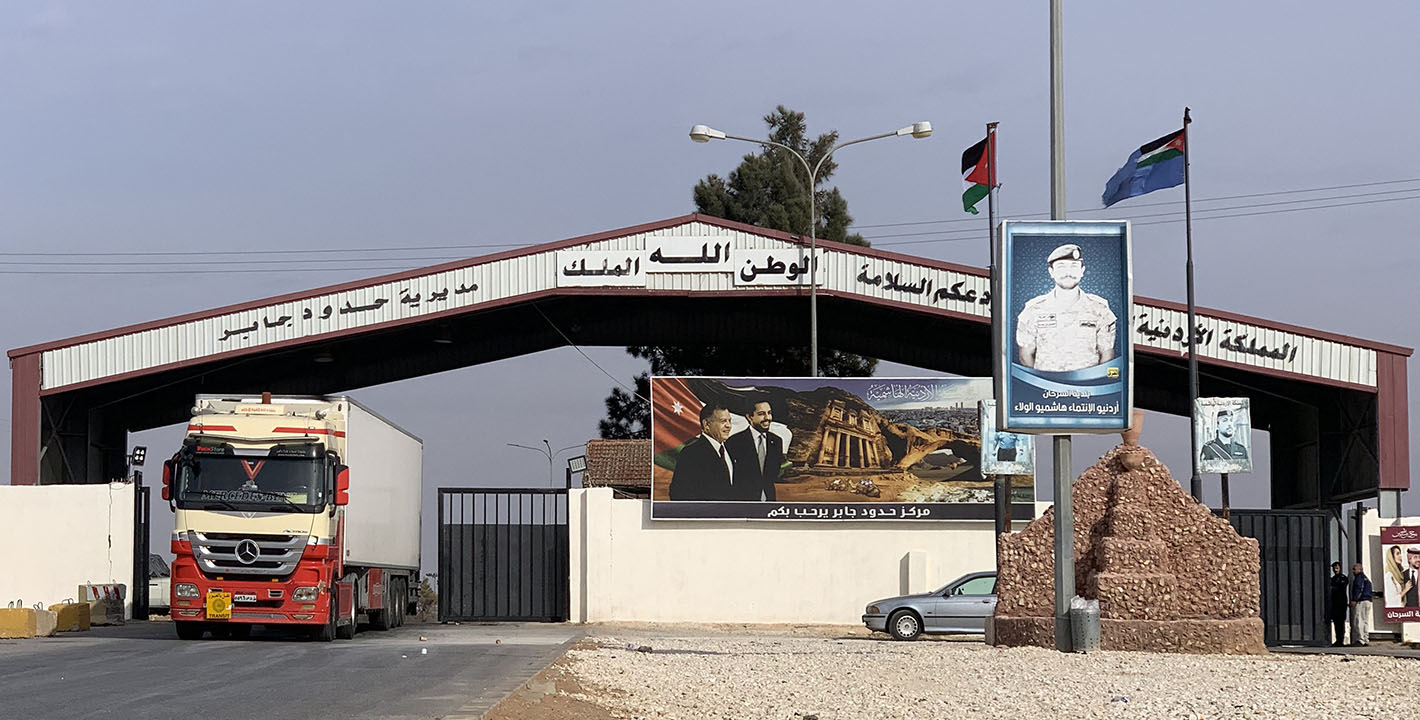
Syria’s border with Jordan has long reflected the state of relations between the two neighbors. The border itself, delineated by France and Britain in October 1931, was tightly enforced only from 1970 onward, after the Black September crisis, when Syrian tanks entered Jordan in support of Palestinian militant organizations.
Since that time, Syria has opened and closed the Nassib-Jaber crossing—the main crossing point between the two countries—several times depending on the political relations between Amman and Damascus. The first decade of the century was something of a golden age for bilateral relations. Syria and Jordan cooperated on many fronts, especially in trade, which reached $674 million in 2007, up 166 percent from 2003. This can be seen in figures released by Jordan’s Department of Statistics, which provides the most detailed and up-to-date figures on the Jordanian economy, converted from Jordanian dinars to U.S. dollars at a rate of $1.41 per dinar. At the time, relations were such that Syria even sought to open a new crossing through Suwayda, alongside Nassib-Jaber and the crossing between Daraa and Ramtha.
In the post-Assad era, the state of the borders continues to reveal something about the two countries’ relations and the condition of their economies. After a decade of full or near closure since 2015, the border has been reopened. Frequent high-level meetings are taking place, most recently in April in Amman, where the two sides signed several memorandums of cooperation. Jordan has also adopted a firmly pro-Damascus line on crucial aspects related to the crisis between the Syrian government and the Druze minority in Suwayda, on Jordan’s doorstep. Trade and official traffic across the border tell us even more. In 2025, bilateral trade nearly reached a record $1 billion, according to Jordan’s Department of Statistics (see graph 1). That total includes Jordanian imports, exports and re-exports. The surge is a sign of relatively good ties and of a political will on both sides to deepen them further.
However, a closer look suggests that Jordan has more reason than Syria to welcome those numbers. Behind the figures lies another story about Syria’s grim economic reality. The first notable pattern in the data is the shift in the trade balance from Syria’s favor to Jordan’s. Until 2013, Syria exported more to Jordan than it imported. At the time, Syria was the larger and more productive economy, especially in the industrial and agricultural sectors. Subsidized energy, skilled but cheap labor, and a diversified export base gave it an edge over Jordan. That balance tilted for the first time in 2014, the year before mutual trade collapsed after the closure of Nassib-Jaber.
The official figures miss the informal trade carried by the so-called bahhara, small traders, mainly Jordanian drivers licensed to enter Syria, who brought goods from Syria into Jordan and sold them for a small profit. This reality had begun to change by 2020, but the real breakdown came in 2025, after Syrian president Bashar al-Assad’s downfall. Of the nearly $1 billion in trade between the two countries in 2025, Syria’s exports accounted for just 12 percent, a stark departure from previous patterns.
The most striking indicator was Jordan’s re-exports. These rose from $151 million in 2023 to $518 million in 2025—an increase of almost 250 percent. The composition of those re-exports also changed. What stood out was Syria’s importation of vehicles from Jordan, which reached a value of $113 million in 2025. If anything, these figures pointed to the pent-up demand from years of Syrian import restrictions. Jordan’s re-export boom, in other words, signaled the removal of some of Syria’s protectionist walls, the reopening of Syria’s markets, and a hunger for import goods.
Jordan’s export of its own products followed a similar pattern, rising from $87 million in 2023 to $360 million in 2025, a record high. Some of these exports were familiar from an earlier time. Jordan had long sold vegetables and root crops to Syria. In 2010, for example, these had topped the kingdom’s exports to Syria, at $44 million.
However, the commodity that led the list in 2025 was less familiar, namely cement, which accounted for almost half of Jordanian exports to Syria. More than simply reflecting the scale of Syria’s destruction, these exports might point to a shortage of local Syrian alternatives and to the difficulty that producers in Syria face in meeting domestic demand. The result is a reliance on imports, draining scarce hard currency reserves. It may also suggest that Syrians have begun a modest reconstruction effort of their own, even as the international community still debates whether, and how, to support the country’s recovery eighteen months after Assad’s ouster.
Syria’s modest exports reinforce the picture of lost productive capacity. Exports to Jordan rose by 77 percent between 2023, the last full year under Assad rule, and 2025. In monetary terms, that meant an increase from $66 million to $117 million. Yet the sole reason was the authorities’ decision to allow the export of sheep and goats, which had previously been blocked. The data show not only that the value of Syria’s exports has shrunk, but their composition has changed. The relatively diversified prewar basket, which included agricultural products, processed food, textiles, metals, plastics, mineral and bituminous products, and machinery, gave way to a narrower wartime basket dominated by food, agricultural products, and live animals. By 2023, the industrial and semi-industrial layer of Syria’s 2010 trade basket had largely disappeared from the top export categories.
Nor is there much left of the informal trade in licit goods that once flooded Jordan’s border cities, especially Ramtha. The prewar informal economy has largely given way to the trade in illicit drugs, which likely remain Syria’s most lucrative export. A single major drug bust in May 2026, involving 25 million Captagon pills, would have been worth some $40 million in Jordan, where each pill’s retail price is estimated at $1.66, and far more had the shipment reached Gulf markets. Suwayda is now often described as a new hub of Captagon production and trafficking, though Syria’s drug economy surely extends well beyond one governorate. Criminals and Syria’s new rulers are adapting to an economy of scarcity, in which drugs still generate large amounts of money.
Jordan has positioned itself well to benefit from the changes in Syria. The available export and re-export figures for January and February 2026 suggest that the pattern is continuing. This would not be the first time a resource-poor but resourceful Jordan has seized such an opportunity. After the removal of Saddam Hussein in 2003 and Iraq’s emergence from years of sanctions, Jordan quickly ramped up its exports and re-exports to the Iraqi market, from roughly half a billion dollars in 2003, the year of the invasion, to almost three times that amount a decade later. The indicators from 2025 suggest that Jordan is well placed to profit from Syria’s recovery, should it happen, but also from the continued weakness of its northern neighbor.
For Syria, in turn, the figures point to a compound challenge. They show not only the destruction of the country’s productive economy after years of conflict, but also the difficulty in reconstituting it. That challenge is likely to persist, especially if the new authorities continue to favor trade over productive industries. Reopening markets may bring goods back to Syria. But it will not, by itself, restore the factories, farms, and supply chains that once allowed Syria to export its goods to Jordan.


Nonresident Scholar Malcolm H. Kerr Carnegie Middle East Center
Armenak Tokmajyan is a nonresident scholar at the Malcolm H. Kerr Carnegie Middle East Center in Beirut. His research focuses on borders and conflict, Syrian refugees, and state-society relations in Syria.
Recent Work
Armenak Tokmajyan
Armenak Tokmajyan

Israel is encroaching on the country’s territory, while the Lebanese look askance at one another.

Issam Kayssi
The party’s domestic and regional roles have changed, so Lebanon should devise a disarmament strategy that encompasses this.

Michael Young

Because perpetual conflict enhances control, offers economic benefits, and allows leaders to ignore popular preferences.

Angie Omar
The community seeks maintain a distance from Hezbollah, and an even greater one from normalization with their southern neighbor.
Mohamad Fawaz
Unless Beirut lowers expectations, any setbacks will end up bolstering Hezbollah’s narrative.

Mohanad Hage Ali