

Commentary
Artyom Shraibman
{
  "authors": [
    "Artyom Shraibman"
  ],
  "type": "commentary",
  "blog": "Carnegie Politika",
  "centerAffiliationAll": "",
  "centers": [
    "Carnegie Endowment for International Peace",
    "Carnegie Russia Eurasia Center"
  ],
  "englishNewsletterAll": "",
  "nonEnglishNewsletterAll": "",
  "primaryCenter": "Carnegie Russia Eurasia Center",
  "programAffiliation": "",
  "regions": [
    "Belarus",
    "Russia",
    "Ukraine"
  ],
  "topics": [
    "Security",
    "Defense",
    "Global Governance",
    "Military",
    "Foreign Policy"
  ]
}
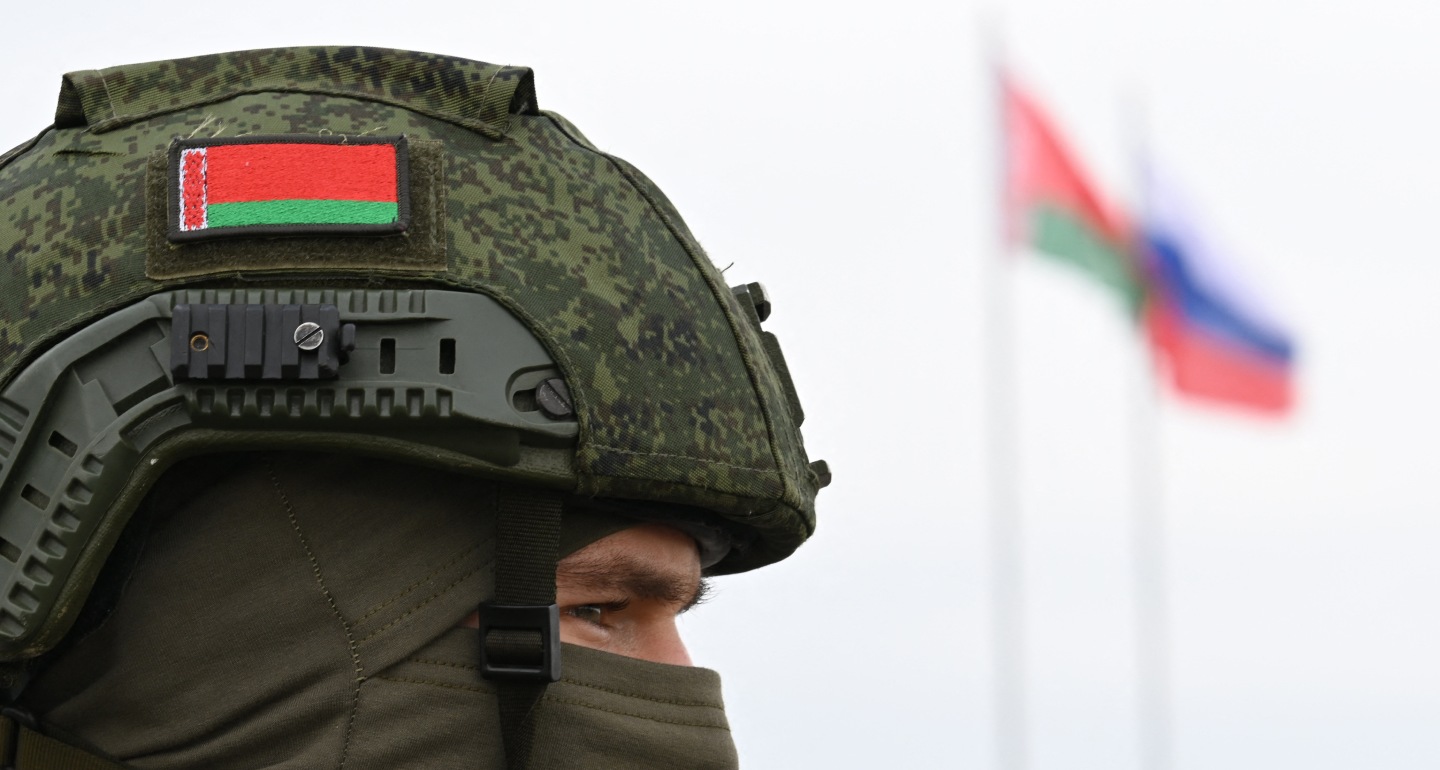
Source: Getty
By reminding the world that Lukashenko is a threat to NATO and Ukraine, Kyiv is trying to return the focus to why the Belarusian regime needs to be contained rather than rewarded.
In May, amid a stalemate on the frontline in Ukraine, senior Ukrainian officials issued several warnings that Belarus was preparing to enter the war. Military experts and monitoring groups insist there are no indications that Belarus is preparing for a repeat invasion of Ukraine (some of the Russian troops who entered Ukraine back in February 2022 did so from Belarus). But the statements and warning signs are becoming too numerous to be dismissed entirely.
Oleksandr Syrskyi, commander-in-chief of Ukraine’s armed forces, has said intelligence data indicates that there are very real plans to launch a new offensive against Ukraine from Belarusian territory. Ukrainian President Volodymyr Zelensky has made thinly veiled references to Belarus repeatedly and has warned that Kyiv is prepared to undertake “preventative measures” with regard to the Belarusian authorities in order to “keep them on their toes.” The commander of Ukraine’s drone forces, Robert “Madyar” Brovdi, recently announced that Kyiv had selected its first 500 targets in Belarus for attack in the event of further Belarusian involvement.
The Ukrainian president has also raised the issue with European leaders. French President Emmanuel Macron, either at Zelensky’s request, or as a result of what his Ukrainian counterpart had told him, called Lukashenko for the first time in over four years to lay out the consequences of getting further involved.
Against this backdrop, and without any warning, Belarus hosted joint nuclear exercises with Russia. Given that elements of the Oreshnik nuclear-capable intermediate-range ballistic missile system were also recently deployed to Belarus, these actions have cemented the country’s status as territory from which Russia sends threatening signals not only to Kyiv, but to the whole of Europe.
There has been on and off talk of a possible repeat invasion of Ukraine from Belarus throughout the war. It can be difficult to distinguish between Kyiv’s genuine concerns based on intelligence data and attempts to rally support from its Western allies. After all, on the one hand, the initial attack on Kyiv in February 2022 was launched from Belarusian territory. Since then, Lukashenko and Minsk have only become more dependent on Moscow, so there is nothing preventing Russia from using Belarus for its military goals once again. In addition, the Belarusian army has been training hard, and tests for combat readiness, mobilization drills, and joint maneuvers with Russia are now a non-stop cycle, adding to suspicions that Minsk is preparing for war.
On the other hand, there are no signs that the level of a direct threat to Ukraine from Belarus has increased compared to 2024 or 2025. About 2,000 Russian troops are permanently stationed in Belarus. Any preparations for a new invasion from Belarus would require Russia to move tens of thousands of soldiers and hardware there, which is not only very difficult to do without anyone noticing; it’s also unclear where Moscow would find these reserves. Even if there were a new wave of mobilization, it would take months to train the new recruits, while moving them from the current frontline would weaken the offensive in the Donbas, which has already stalled.
Given how combat technology has changed since the start of the war, there would be no point in Moscow sending in infantry and tanks to march on Kyiv again: it didn’t work last time and there’s no reason it would a second time around. The border has been fortified and mined, an attack would not have the element of surprise, given a buildup of troops in Belarus, and Ukrainian drones would reduce the speed of such an offensive to the same agonizing pace we are seeing in the Donbas.
At the same time, Minsk’s increased involvement in the war would untie Kyiv’s hands. Belarusian territory would be a convenient target for Ukrainian drones, given how much closer it is to Ukraine than most of Russia’s territory. Ukraine would be able to set its sights on military infrastructure and defense industry enterprises being used by the Russian army, as well as energy infrastructure including two major oil refineries that have become an important fuel reserve for the European part of Russia when its own refineries are offline as a result of Ukrainian strikes.
In other words, if the potential benefits and losses from involving Belarus in the war are weighed up, the outcome looks dubious for both Moscow and in particular for Minsk. That is no guarantee against the worst-case scenario, of course. After all, Putin’s decision to invade Ukraine in 2022 was not rational either. Russia could also try to involve Belarus in the war in a less direct way, such as resuming strikes against Ukraine via Belarusian air space.
For now, however, this looks like undue speculation. There is a more logical explanation for the statements on the issue coming from Kyiv.
Talk about the threat posed by Belarus is in keeping with Ukraine’s policy regarding Minsk, which has becoming increasingly tough during the last six months. In that time, Zelensky has introduced two new sanctions packages against Lukashenko and his associates, met for the first time with Belarusian opposition leader Sviatlana Tsikhanouskaya in Vilnius, and also recently received her in Kyiv.
In all likelihood, this is the Ukrainian leadership’s way of expressing its disapproval of the developing dialogue between Minsk and Washington. Not only has the United States eased its own sanctions, it recently started putting gentle pressure on Poland, Lithuania, and Ukraine to allow Belarusian potash to be exported to the United States via their ports.
Making diplomatic and economic concessions to Lukashenko after he allowed Russian troops to launch their march on Kyiv from his territory back in 2022 looks like a travesty of justice to Ukraine, especially while the war is ongoing. Kyiv is apparently worried that having trialled this scheme with Lukashenko, this creeping normalization of relations could be extended to relations with Russia.
By loudly reminding the world that Lukashenko is a military satellite of Putin and a threat to NATO and Ukraine, Kyiv is trying to return the focus to why the Belarusian regime needs to be contained, rather than rewarded. Zelensky is making it clear that not only will he not join U.S. policy, but that Ukraine is prepared to be the most hawkish country in Europe on Belarus.
No less importantly, in the last six months, Ukraine has realized that its increased military capabilities—especially in the field of long-range strikes—have made it incomparably stronger than Belarus. Lukashenko is incapable of posing a comparable counter-threat to Ukraine without outside assistance, even if he wanted to.
Since Russia’s actions are not dictated by how Lukashenko feels about Ukraine, keeping Minsk “on its toes” no longer carries any real risks for Kyiv, and can therefore be done from time to time purely as a deterrent. There is no incentive for Kyiv to rein in its rhetoric.
Minsk is also very aware of the difference in its potential. For months after Ukraine toughened its stance on Belarus, Lukashenko kept quiet. Finally, on May 21—during the joint exercises with Russia—he broke his silence. Lukashenko invited Zelensky to meet with him at a place of the latter’s choosing to discuss the problems in their countries’ relations, and assured him that Belarus would only be drawn into the war if it was attacked first.
That is remarkable restraint for a man who just three years ago called Zelensky a “scumbag,” bragged of Russia’s nuclear arsenal, and predicted an imminent crushing defeat for Ukraine.
Lukashenko apparently fears that the current verbal escalation may indeed be a prelude to getting dragged into the war—only not by Russia, but by Ukraine. First it will talk at length about the threat posed by Belarus, then it will decide to take “preventive” action to neutralize that threat.
If Kyiv’s goal was to frighten Lukashenko into avoiding further involvement in the war at all costs, then the Ukrainian government can be satisfied with its efforts. Fear and confusion as to where this is all going are written on Lukashenko’s face for all to see.

Nonresident Scholar, Carnegie Russia Eurasia Center
Artyom Shraibman is a nonresident scholar at the Carnegie Russia Eurasia Center.
Recent Work
Artyom Shraibman
Artyom Shraibman
Carnegie does not take institutional positions on public policy issues; the views represented herein are those of the author(s) and do not necessarily reflect the views of Carnegie, its staff, or its trustees.

The demands of the Kremlin’s war in Ukraine, demographic problems, and public hostility toward Central Asians mean Russia does not have enough workers.

Salavat Abylkalikov
Minsk’s faith in the future of its larger neighbor’s economy is fading as Belarusian firms in Russia see record losses.

Olga Loiko
With no key agreement signed on the Power of Siberia 2 gas pipeline, there is a risk that the window of opportunity for Russia will close if Chinese power generation becomes so green that new gas sources are no longer of any interest to Beijing.

Alexander Gabuev
Though Orban is gone, Putin can still count on some like-minded individuals in Central and Eastern Europe. However, they will seek to avoid open confrontation with EU institutions over Ukraine and their ties with Moscow.

Dimitar Bechev
The truth is that Japan’s government is seeking a degree of reengagement but at a vastly reduced level than under Abe. Most significantly, Japan has shown no willingness to ease sanctions.

James D.J. Brown